What Is an Online Business Manager And How Is It Different From Hiring Help?
You brought someone in to take work off your plate. Six months on, the work gets done, and you are still the one deciding what the work is.
That is not a criticism of the person, and it is not a criticism of the decision. It is what happens when the thing you needed was structure and the thing you bought was capacity. Both are real forms of support. They solve different problems, and the gap between them is the reason "I need more help" so often turns into "I need more help managing the help."
If you have been searching for an online business manager, or wondering whether there is something between a task list and a full operations appointment, this is the difference.
What is an online business manager?
An online business manager, or OBM, takes ownership of how your business runs rather than of the tasks inside it.
The role is defined by what it is responsible for. Task-based support is responsible for output: the email goes out, the invoice is raised, the document is formatted properly. An OBM is responsible for the system that produces the output, which means deciding what should exist, building it, and owning whether it holds up when you are not watching.
In practice, that covers:
Designing and building the systems the business runs on, then documenting them so someone other than you can follow them
Managing projects from scope through to handover, including the parts nobody thought to assign
Choosing and connecting the tools, so the same information stops living in four places
Finding where the work catches every time, and fixing the cause rather than absorbing it again
Holding the operational side of the business, so your attention goes to delivery, clients and growth
The short version: capacity gets more done. Structure changes what needs doing.
Virtual business management compared with task-based support
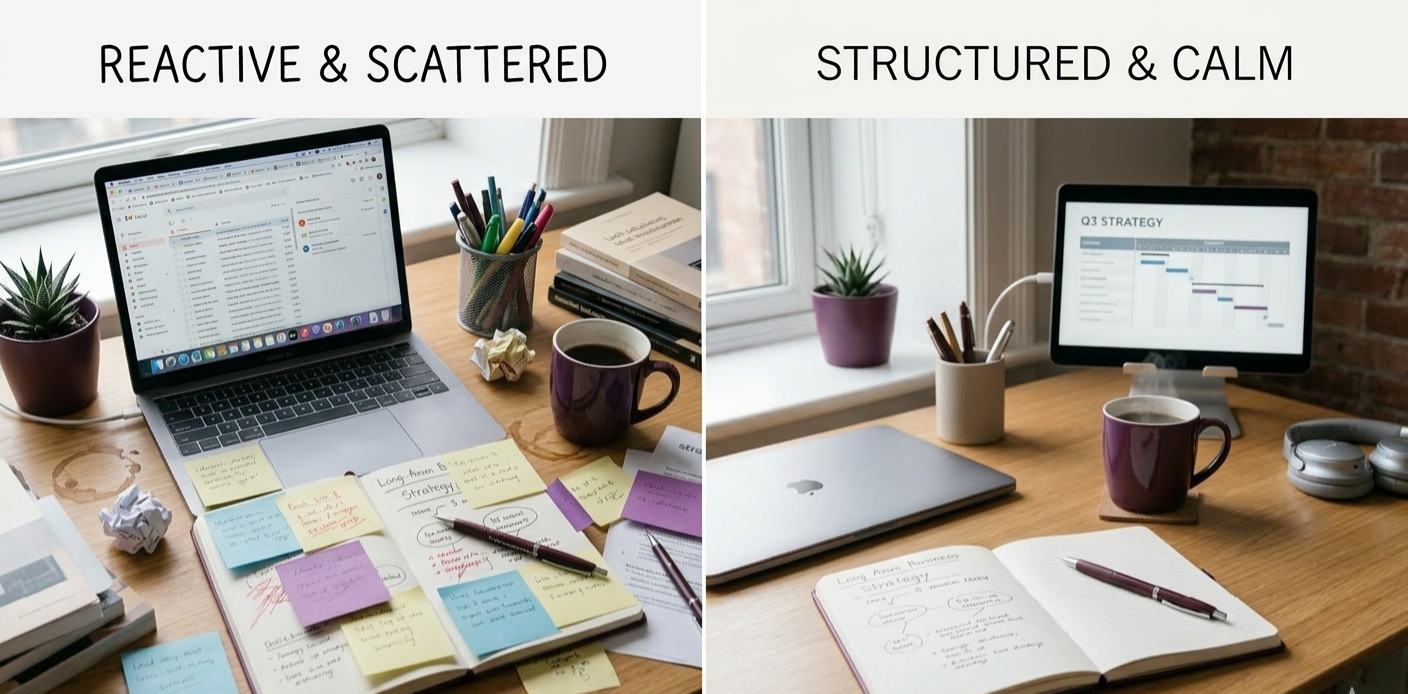
Task-based support is transactional by design, and that is a feature rather than a fault. You bring a defined piece of work, it comes back done, you bring the next one. For bounded, repeatable work it is the right answer and usually the less expensive one, and I would not talk anyone out of it.
What it cannot do is decide what the work should be. That decision stays with you, which is why the load rarely drops as far as you expected. You moved from doing to directing, and directing is still your hours.
Virtual business management sits on the other side of that line. A behind-the-scenes business partner understands the business model, the numbers, and where the pressure actually is, and makes operational decisions inside an agreed scope without bringing each one back to you.
Neither replaces the other. Most established businesses eventually want both: someone running the systems, and someone working inside them.
A test for which one you need
Does the problem get smaller each time you solve it?
If you fix the same thing every quarter and it returns every quarter, you are buying capacity against a structural problem. Adding hours to a process that does not work gets you a faster version of the same result.
Who an online business manager for coaches, consultants and service businesses suits
The businesses that get the most from this are past the early stage. There are clients, there is revenue, and there are people, employees or contractors, who now depend on the owner's decisions. What has not kept pace is the structure underneath, because it was built in the gaps between client work and never quite finished.
You will recognise the position if:
The processes exist, but they exist as habits rather than as anything written down
You have bought the tools and started the setup twice
The final say on operational detail is still yours, on decisions you would rather not be making
None of that means the business is struggling. It is the ordinary result of growth arriving faster than infrastructure, and it is the stage where strategic support does the most work.
How this runs at Trace Assists
Every engagement opens the same way: a proper look at how the business actually operates, which systems are missing, where the same problem keeps returning, and what is costing you the most time. That produces an order of work rather than a wish list, because the order matters more than the list does.
Then it gets built. The systems, the tools, the connections between them, and the documentation, so the structure outlasts the person who set it up.
Some of that is a single project, one system put in properly. Some is the whole operation, mapped and rebuilt. And some businesses want it held on an ongoing basis by someone close enough to make the call without asking first.
What does not change is that it is shaped around how your business works. Structure creates freedom, and here the freedom is specific: fewer decisions arriving at your desk, a business that behaves the same way every time, and enough room to think about where it is going.
Could your business run for two weeks without you?

That question sorts capacity from structure faster than anything else. If the honest answer is no, the gap is not effort.
The Two-Week Test is a short diagnostic across the five areas that decide it: Lead Flow & Pipeline, Sales & Conversion, Delivery & Operations, Team & Delegation, and Numbers & Cashflow. It takes a few minutes and it tells you which one is carrying the weight.